
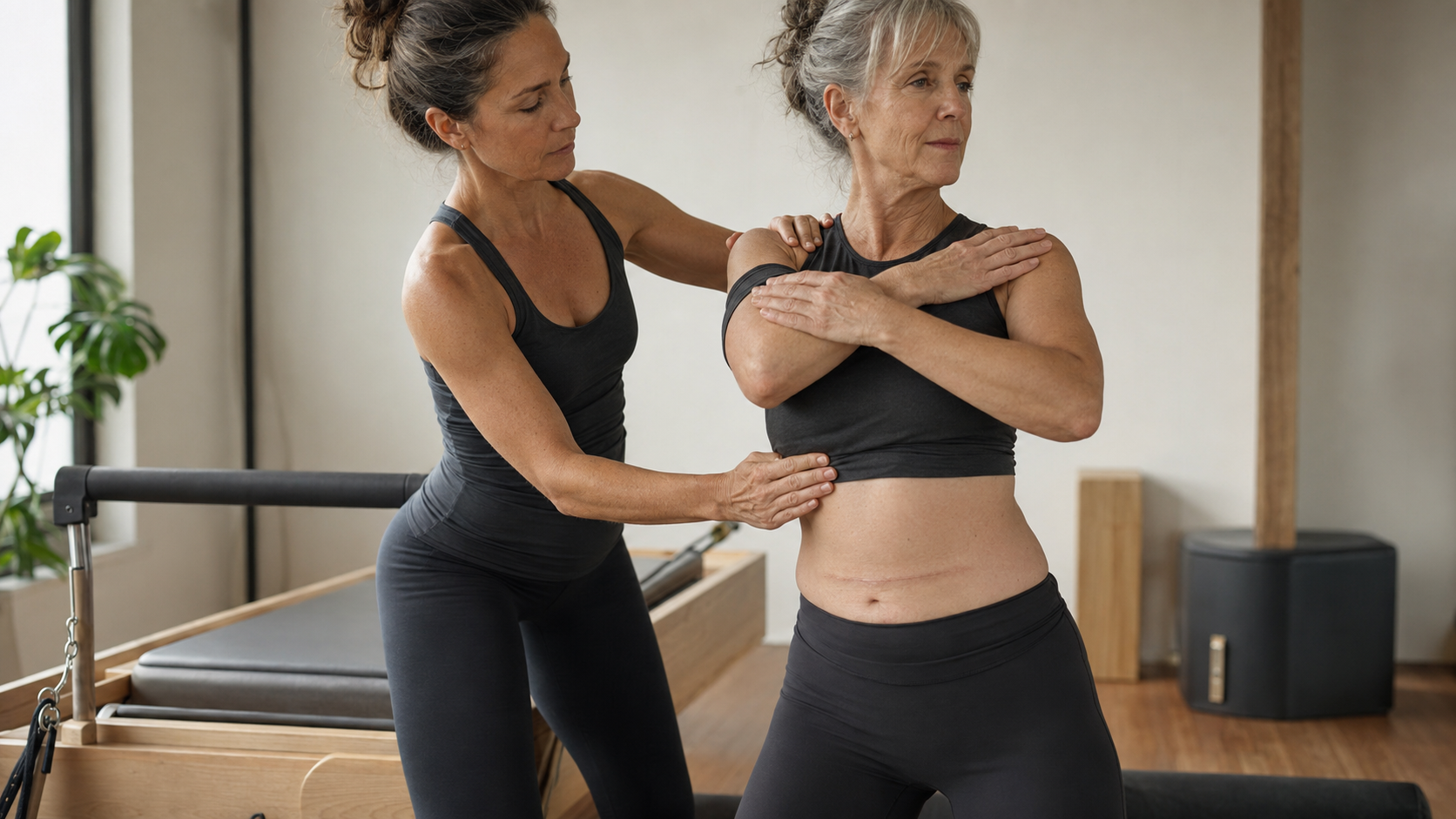
The Scar Has Healed – So Why Are You Still Moving Differently?
The incision has closed. The swelling has settled. The scar may have faded from red to a fine pale line. Your doctor may even have told you that everything has healed well.
So why does reaching overhead still feel tight? Why do you rotate more easily to one side? Why has your stride shortened, or why does one hip, shoulder or side of your back seem to work harder than it did before?
A scar can be healed at the surface while the tissues underneath – and the movement patterns around it – are still behaving differently.
This does not automatically mean that something is wrong or that every tight area is an adhesion. It does mean that healing and returning to comfortable, confident movement are not always the same thing.
What happens when scar tissue forms?
Scar tissue is a normal and essential part of healing. After surgery or injury, the body produces collagen to repair and strengthen the damaged area. Early in the process, these new fibres are laid down quickly. Over time, the scar remodels and usually becomes softer, flatter and more flexible.
However, scar tissue is not identical to the tissue it replaces. In some people, it can become thick, sensitive or less mobile. Scarring can also occur below the skin, where tissue layers may become less able to slide over one another.
These areas of binding are often described as adhesions. An adhesion is not simply a visible line on the skin; it involves tissue that has become attached to nearby layers or structures. That is why a neat-looking scar does not always tell us how freely the area beneath it is moving.
It is also important not to blame every restriction on scar tissue. Joint stiffness, muscle weakness, swelling, nerve sensitivity, pain and time spent moving less during recovery can all contribute. A whole-body movement assessment helps determine what is actually limiting you.
Why tissue glide matters
Healthy movement depends on more than muscles contracting and joints bending. Skin, connective tissue, fascia and muscle need to move in relation to one another as you reach, breathe, walk and rotate.
If one area does not glide comfortably, the body will usually find another way to complete the task. It may be a very small adjustment at first, but repeated over months or years it can become your new normal.
For example:
- An abdominal or Caesarean scar may be associated with a pulling sensation when standing tall, extending the hip or rotating through the trunk.
- A scar across the chest, breast or underarm may make raising the arm or rotating the upper body feel guarded.
- A knee or hip scar may contribute to avoiding full joint movement, shifting weight to the other side or shortening a step.
- A scar near the shoulder may change how the shoulder blade, ribs and upper spine coordinate during reaching.
The restriction may be local, but the compensation can travel. A body that avoids movement at the hip may ask more of the lower back. Limited chest or shoulder mobility may lead to extra movement through the neck. Reduced rotation on one side can alter walking, driving, gardening, golf and many other everyday activities.
The restriction is not always purely mechanical
Surgery and injury also affect the nervous system.
When an area is painful or vulnerable, the brain naturally protects it. You may brace, reduce your range, hold your breath, favour one side or stop loading the area. These are sensible short-term strategies.
The difficulty is that the protective pattern can remain after the original need for protection has passed. The tissues may have healed, but the nervous system has become very efficient at using the workaround.
This is one reason stretching the tight area is not always enough. Restoring movement may require three things:
- improving the mobility and tolerance of the affected tissues
- rebuilding strength and control through the available range
- giving the nervous system repeated, safe experiences of a more efficient movement pattern
Signs an old scar may be worth assessing
A scar may be relevant to your movement if you notice:
- pulling, puckering or a sense of tethering around the scar
- skin that moves less freely in one direction than the surrounding area
- numbness, sensitivity or discomfort that persists after healing
- a clear difference between sides when reaching, rotating or bending
- difficulty standing fully upright or taking a comfortable full breath
- a change in stride, weight-bearing or joint range since surgery or injury
- an area that continues to feel guarded despite regaining general strength
- another part of the body repeatedly becoming tight or overloaded
These signs do not diagnose an adhesion. They simply provide useful clues for a practitioner assessing how the scar, surrounding tissues and the rest of the body are moving together.
What does Scar Tissue Therapy involve?
At Balance & Restore Wellness, Scar Tissue Therapy is a gentle, hands-on approach. Appropriate pressure is applied to the surface scar and surrounding tissues while the practitioner follows lines of tension through deeper layers.
The aim is not to aggressively “break up” a scar. Scar tissue is part of your body and has performed an important repair job. The goal is to encourage better mobility between tissue layers, reduce unnecessary restriction and improve how the area tolerates touch and movement.
Some people notice that the scar feels softer or less sensitive. Others become aware that a nearby joint moves more freely or that they can stand, reach or rotate with less pulling.
Research into physical scar management is promising but still developing. A 2020 systematic review found beneficial effects across several scar signs and symptoms, while a 2025 scoping review noted wide variation in techniques, scar types and study quality.
In practical terms, treatment should be individualised and outcomes should be measured by meaningful changes in comfort and function – not by promises to “erase” scar tissue.
Why add tailored Pilates?
Hands-on treatment may improve the opportunity for movement. Pilates helps the body learn how to use that opportunity.
At Pilates Connection, the programme can be adapted to the person’s surgery or injury history, current strength, joint range and goals. Rather than applying a generic set of post-surgery exercises, we look at what happens through the whole movement chain.
Depending on the location of the scar, tailored Pilates may focus on:
- restoring comfortable breathing and rib movement
- gradually reintroducing trunk rotation
- improving shoulder and shoulder-blade coordination
- regaining hip or knee extension for walking
- rebuilding abdominal and pelvic control without excessive bracing
- loading the affected side with better alignment and confidence
- integrating new range into reaching, lifting, stepping and balance tasks
The Pilates apparatus is particularly useful because resistance and support can be adjusted. This allows us to introduce movement gradually, observe compensations and build control without forcing a joint or tissue beyond what it is ready to manage.
In other words, Scar Tissue Therapy addresses the tissue restriction directly, while Pilates develops the strength, coordination and confidence needed to make the change usable.
A combined approach: release, retrain and reinforce
When Scar Tissue Therapy and tailored Pilates are used together, the process may look like this:
1. Assess the whole body
We discuss the surgery or injury, healing history, symptoms and medical guidance. We then observe posture, breathing, joint range and the way you perform relevant movements.
2. Address appropriate tissue restrictions
Hands-on therapy is directed only where the assessment indicates that the scar and surrounding tissues may be contributing to the restriction.
3. Reintroduce the missing movement
Pilates exercises are selected to help you explore the new range with support, control and appropriate resistance.
4. Reinforce it in functional tasks
The aim is not simply to create a temporary feeling of looseness on the treatment table. We want the change to carry into walking, reaching, lifting, sport and daily life.
5. Reassess
Range alone does not tell the whole story. We look for practical improvements: a more even stride, an easier reach, smoother rotation, less bracing or better confidence using the affected side.
Having Pilates and Balance & Restore Wellness services within the same Lane Cove studio means the scar does not need to be treated in isolation from the rest of your movement programme.
When is Scar Tissue Therapy appropriate?
Scar Tissue Therapy should never be applied to a fresh, open or inflamed wound.
At Pilates Connection and Balance & Restore Wellness, guidelines require a scar to have at least six months of healing before hands-on Scar Tissue Therapy is considered. Medical clearance may also be needed depending on the surgery, injury and your current health.
See your doctor promptly if a scar or surgical area becomes increasingly red, hot, swollen or painful; begins to bleed or discharge; reopens; or is accompanied by fever or feeling unwell. New or worsening symptoms need medical assessment before manual therapy or exercise.
Healing is not the end of rehabilitation
A healed scar is evidence that your body has repaired itself. But if you are still adapting how you stand, breathe, walk, rotate or reach, there may be another part of recovery worth addressing.
This matters for longevity because small compensations can quietly reduce the movement options available to you. The goal is not perfect posture or maximum flexibility. It is having enough comfortable, controlled movement to keep doing what life asks of you – whether that means lifting a grandchild, turning to reverse the car, reaching into a cupboard, walking up a hill or returning to a favourite sport.
Curious whether an old scar may be contributing to the way you move?
At Pilates Connection and Balance & Restore Wellness in Lane Cove, we can assess the relationship between the scar, surrounding tissues and your whole-body movement pattern, then tailor the approach to you.
Contact Pilates Connection to arrange an initial consultation or call 0400 012 693.
This article provides general information only and is not a diagnosis or substitute for medical care. Follow the advice of your surgeon or treating health professional after surgery or injury.
Sorry, the comment form is closed at this time.