
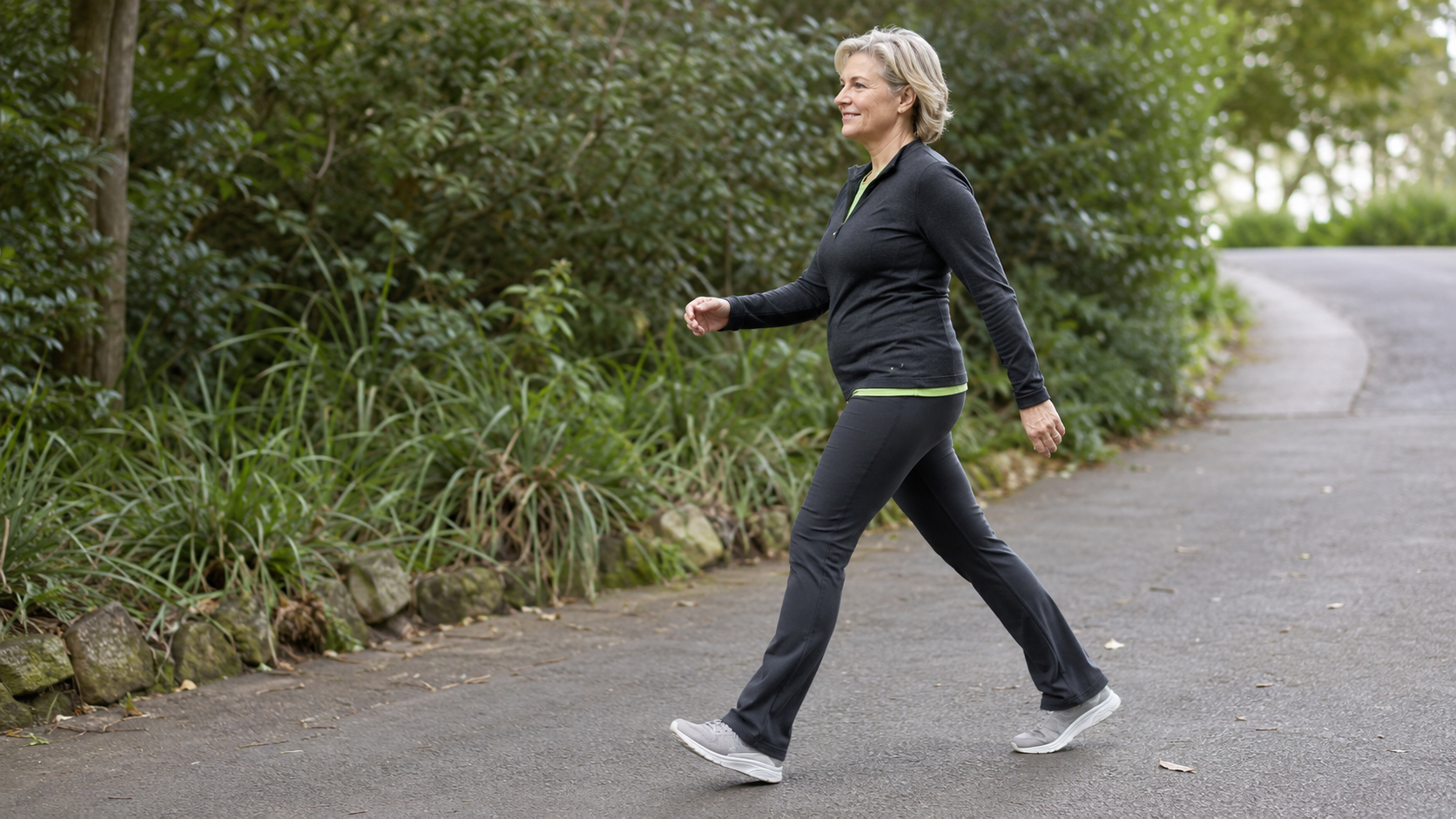
Why Your Stride Is Shortening: What Reduced Hip Extension Means for Your Back and Knees
Have you noticed that you are taking more steps to cover the same distance? Perhaps someone else seems to walk away from you on hills, or your lower back or knees begin to complain after a longer walk.
It is easy to assume that you simply need to walk more. But there is an important difference between how far you walk and how well your body is moving while you do it.
One part of the walking cycle that often becomes less available over time is hip extension: the ability of the thigh to travel behind the pelvis as you move forwards. It may look like a small detail, but it plays an important role in stride length, propulsion and the way load is shared through the body.
This is particularly relevant for anyone preparing for the 14-kilometre City2Surf or the 35-kilometre Bloody Long Walk. Over a short stroll, the body may compensate without creating obvious symptoms. Add distance, hills and fatigue, and those small compensations are repeated thousands of times.
What should your hip do when you walk?
As your front foot lands, your body travels forwards over that leg. Meanwhile, the opposite leg moves behind you before the toes leave the ground and swing forwards for the next step.
That moment, when the back leg is behind the body, requires hip extension.
True hip extension means the thigh bone moves behind the pelvis while the pelvis and spine remain reasonably organised. It does not mean pushing the hips forwards, arching the lower back or forcing a longer step.
When the movement is available and well controlled, it helps to create:
- A comfortable stride length
- Efficient transfer of body weight from one leg to the other
- Effective use of the gluteal muscles
- A stronger trailing-leg position for forward propulsion
- Smoother coordination between the hip, knee, ankle and foot
Research comparing healthy younger and older adults has found that reduced peak hip extension can remain evident even when walking speed is taken into account. The same research also identified increased forward pelvic tilt and reduced ankle push-off power in the older group. In other words, the change was not simply because the older adults chose to walk more slowly. Read the gait study
Why can hip extension become reduced?
There is rarely one explanation.
Hip extension during walking depends on the joint itself, the tissues surrounding it and the way the whole body coordinates the movement. It may be influenced by:
- Reduced mobility at the front of the hip
- Changes in muscle and fascial flexibility
- Gluteal muscles that are not producing or controlling force effectively
- Reduced ankle mobility or calf strength, limiting push-off
- Previous hip, knee, ankle or lower back pain
- Arthritis, injury or surgery
- Long-established posture and movement habits
- A cautious walking pattern after a fall or period of inactivity
- Differences between the left and right sides of the body
Time spent sitting may also be relevant because the hips remain flexed for long periods, but it is too simplistic to blame every restriction on “tight hip flexors”.
A person may have adequate range when lying on a treatment table yet still fail to use that range while walking. Another person may appear flexible but lack the strength or pelvic control to move through the available range.
This is why stretching one muscle is not always the answer.
How does a shorter stride affect the back and knees?
The body is very good at finding another way to complete a movement. That adaptability is useful, but the alternative strategy may distribute work differently.
The lower back may create movement that the hip is not providing
If the thigh cannot travel far enough behind the pelvis, some people tip the pelvis forwards or extend and rotate through the lower back to keep moving. This can make the step look longer without creating genuine extension at the hip.
That does not mean reduced hip extension automatically causes back pain. Back pain is complex and can have many contributing factors. However, repeatedly asking the lumbar spine to supply movement that should be shared with the hip may increase demand on the area, especially during faster walking, hills or longer distances.
The knees may remain more involved
A shorter step can keep the body in a more flexed strategy, with less time moving fully over and beyond the stance leg. On hills and stairs, where the knees already have more work to do, limited contribution from the hips can make the imbalance more noticeable.
Again, this is not a simple cause-and-effect diagnosis. Knee symptoms may arise from the knee itself, the foot and ankle, the hip, training load or several factors together.
The important point is that the painful area is not always the only area that needs to be assessed.
The feet and ankles may compensate
Some people lift the heel early, turn a foot out or reduce push-off through the toes. Others increase their cadence and take more, smaller steps. These strategies can keep you moving, but they may make walking less efficient over distance.
Signs you may not be using hip extension well
You cannot diagnose a movement restriction from one symptom, but the following patterns may justify a closer look:
- Your stride has gradually become shorter
- One step is noticeably shorter than the other
- You feel pulling or pinching at the front of a hip when walking quickly
- Your lower back becomes tired before your legs do
- Hills or stairs bring on knee discomfort
- One foot turns out or one heel lifts early
- You feel as though you are shuffling rather than moving over the ground
- You can walk a short distance comfortably, but symptoms appear as the kilometres accumulate
A simple observation can also be useful. Stand in a small split stance with one foot behind you. Keeping your trunk upright, gently move your weight forwards. Can the back thigh move behind the pelvis without the lower back arching, the pelvis rotating or the back foot turning out?
This is not a clinical test, and there is no need to force the movement. It is simply a way to notice whether your body immediately finds an alternative route.
Why walking more may not change the way you walk
Walking is excellent exercise. It supports cardiovascular health, bone health, mood, social connection and independence.
However, walking also rehearses your current walking pattern.
If you are already compensating, adding distance may improve endurance without restoring the missing movement. This helps explain why someone can be very active and still experience the same recurring tightness or one-sided discomfort whenever their distance increases.
Research in older adults with limited hip extension has shown that a supervised, targeted hip-flexor stretching programme can improve passive hip range and, in those who began with restricted hip extension during walking, improve stride length and peak hip extension. Read the supervised intervention study
The key words are targeted and supervised. The study does not mean that everybody needs the same hip-flexor stretch. It supports assessing the restriction first and matching the intervention to the person.
What should a useful movement assessment examine?
At Pilates Connection and Balance & Restore Wellness, we do not look at the hip in isolation. Depending on the person, an assessment may consider:
- Hip mobility on both sides
- The position and control of the pelvis
- Gluteal strength and timing
- Abdominal and trunk control
- Ankle mobility and calf function
- Foot position and push-off
- Balance and confidence on one leg
- Differences in step length or weight transfer
- Previous injuries, surgery, pain and current training load
The goal is not to manufacture the longest possible stride. Overstriding can create its own problems.
The aim is to restore an efficient, comfortable stride that suits your body, your pace and the activity you want to perform.
How Pilates, Stretch Therapy and Structural Integration can help
Different restrictions require different tools.
Equipment-based Pilates
The springs, straps and moving surfaces used in our fully equipped studio allow us to work on hip extension while controlling the position of the pelvis and spine.
A tailored programme may develop:
- Gluteal strength
- Hip and trunk dissociation
- Pelvic stability
- Single-leg control
- Calf strength and ankle mobility
- Balance, coordination and load transfer
Because sessions are private, duet or small group, exercises can be adjusted for your mobility, symptoms, health history and walking goals.
Stretch Therapy
One-on-one Stretch Therapy may be useful when specific muscular or myofascial restrictions are limiting comfortable movement.
Sessions can incorporate PNF techniques, targeted myofascial and trigger-point work, and gentle eccentric stretching using specialised spring-loaded equipment.
The purpose is not to push the hip into an arbitrary range. It is to improve usable movement while respecting the structure and needs of the individual.
Structural Integration
When a restriction is part of a longer-standing whole-body pattern, Structural Integration offers a broader assessment of posture, fascial relationships and biomechanics.
This may be relevant when the body has been compensating after an old injury, surgery or years of favouring one side.
Hands-on work can then be supported with Pilates to help the nervous system practise and retain a more efficient movement pattern.
A better stride is about longevity, not speed
Stride length naturally varies with height, pace, terrain and confidence. A shorter stride is not automatically a problem, and nobody needs to walk like an athlete to age well.
What matters is whether your walking pattern is comfortable, adaptable and capable of meeting the demands of your life.
Can you lengthen your pace when crossing a road? Can you manage a hill without your back or knees taking over? Can you walk for pleasure, travel, keep up with family or complete an event without the same area becoming overloaded?
These are longevity questions.
Walking further is valuable. Walking well enough to keep doing it for years to come is even more important.
Curious about your walking pattern, hip mobility or why one side works harder?
At Pilates Connection and Balance & Restore Wellness in Lane Cove, we assess the way your whole body moves and tailor the approach to the individual.
Your programme may include equipment-based Pilates, targeted Stretch Therapy, Structural Integration or a combination of services.
Contact Pilates Connection to arrange an assessment and take a closer look at what may be limiting your stride.
This article provides general information only and is not a diagnosis or substitute for medical care. Seek prompt medical advice for sudden or severe pain, symptoms following a fall, an inability to bear weight, significant swelling, fever, or a joint that locks or gives way
Sorry, the comment form is closed at this time.