
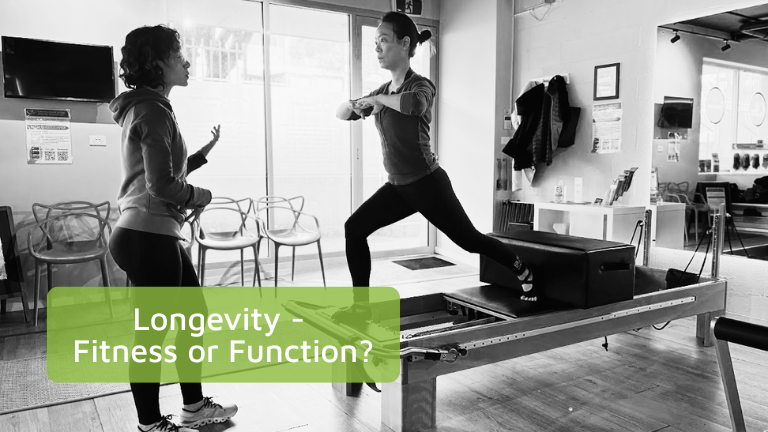
Longevity Isn’t About Fitness – It’s About Function
We’ve Been Thinking About Longevity All Wrong
When most people think about ageing well, they picture someone who is “fit.”
Maybe they walk every day, go to the gym occasionally, or can still touch their toes.
But true longevity isn’t simply about fitness levels.
It’s about function.
❓Can you confidently get up off the floor?
❓Can you carry groceries without straining your back?
❓Can you react quickly if you trip?
❓Can you rotate your body easily to reverse the car or reach behind you?
These are the movements that determine how independently, comfortably and confidently we move through life as we age.
And surprisingly, they’re often the first things we begin to lose.
Longevity Lives in Everyday Movement
One of the biggest misconceptions about ageing is that decline happens suddenly.
In reality, it’s usually gradual.
A little less balance.
A little more stiffness.
A slightly slower reaction time.
Small losses in mobility that slowly change how we move.
Over time, the body adapts around these changes – often creating compensation patterns that place more strain on joints, muscles and the spine.
That’s why longevity isn’t about chasing extreme fitness goals. It’s about maintaining the quality of everyday movement for as long as possible.
Things like:
- Stability
- Mobility
- Coordination
- Balance
- Strength
- Breathing efficiency
- Postural control
These are the real foundations of functional ageing.
Why Function Matters More After 40
From around our 40s onwards, the body naturally begins to change.
Research shows we gradually lose muscle mass, joint mobility, bone density and reaction speed as we age. If left unaddressed, these changes can affect:
- Balance
- Independence
- Confidence in movement
- Injury risk
- Overall quality of life
One area many people don’t realise declines early is rotational movement.
Rotation is involved in almost everything we do:
- Walking
- Reaching
- Driving
- Sport
- Preventing falls
When the body loses the ability to rotate well, other areas compensate. This often contributes to stiffness, lower back discomfort and inefficient movement patterns.
The good news? These skills can absolutely be trained and improved.
Balance Is More Than Standing Still
When people hear “balance training,” they often imagine standing on one leg.
But real-life balance is far more dynamic than that.
True balance is your body’s ability to react quickly and efficiently when something unexpected happens.
For example:
- Stepping awkwardly off a curb
- Catching yourself if you trip
- Adjusting your posture when carrying something heavy
- Turning quickly without losing stability
This reactive ability becomes increasingly important with age.
At Pilates Connection, we incorporate controlled balance and stability work into sessions in a way that feels supportive – not intimidating.
Because confidence in movement is just as important as strength itself.
Breathing: The Overlooked Piece of Longevity
Another often-overlooked factor in functional movement is breathing.
Most people think of the core as simply abdominal muscles, but your core system also includes:
- The diaphragm
- Pelvic floor
- Deep stabilising muscles
- Postural support muscles
When breathing becomes shallow or inefficient, the body loses part of its natural support system.
This can contribute to:
- Poor posture
- Neck tension
- Reduced spinal support
- Decreased movement efficiency
That’s why breathwork is integrated into Pilates sessions – not as a trend, but as a foundational part of how the body stabilises and moves well.
The Social Side of Longevity
Interestingly, longevity isn’t only physical.
Studies increasingly show that strong social connections are one of the most important predictors of living a longer, healthier life.
People with meaningful social interaction tend to experience:
- Better mental health
- Lower stress levels
- Reduced risk of chronic disease
- Greater overall wellbeing
It’s something we see naturally happen within our studio every day.
Our small group environment allows people to form genuine connections while moving their bodies in a supportive, welcoming space.
Sometimes the benefits extend far beyond the exercise itself.
Why Personalised Movement Matters
Not every body moves the same way.
That’s why personalised guidance becomes more important as we age.
At Pilates Connection, sessions are tailored to the individual – whether you’re managing injuries, improving mobility, building strength or simply wanting to move more confidently for the long term.
Using specialised Pilates equipment and small group sessions, we focus on precision, control and movement quality rather than pushing through pain or chasing exhaustion.
Because longevity isn’t about punishing the body.
It’s about supporting it.
Final Thoughts
Living longer is one thing.
Living well is another.
True longevity is about maintaining the ability to move freely, react confidently, stay connected socially, and continue doing the things you love for as long as possible.
That’s why functional movement matters.
Because the goal isn’t simply more years in life – it’s more life in those years.
Sorry, the comment form is closed at this time.