
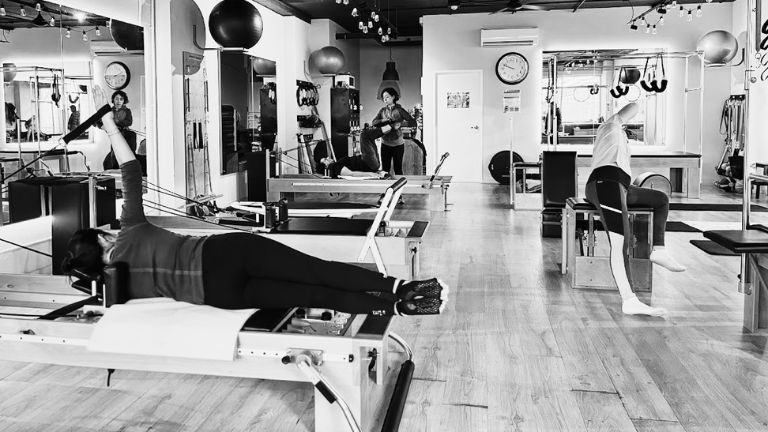
Join the resistance. Stay stronger for longer.
How Pilates uses body weight and equipment to build strength for healthy ageing.
Getting out of a low chair. Carrying the shopping. Climbing stairs. Lifting a suitcase.
These everyday movements all depend on strength. As we get older, maintaining that strength becomes an investment in our ability to keep doing the things we enjoy.
You may have heard that resistance training is essential for healthy ageing. But what exactly is it, and where does Pilates fit in?
What is resistance training?
Resistance training is exercise that makes your muscles work against a force. You might push, pull, lift or hold a position against resistance.
That resistance can come from weights, elastic bands, springs or your own body weight working against gravity. Although lifting dumbbells is one example, it is far from the only way to train.
When the challenge is appropriate and repeated consistently, your muscles adapt and become stronger. This is why resistance training is also commonly called strength training.
How does it differ from cardio?
Cardio, or aerobic exercise, raises your breathing and heart rate for a sustained period, helping improve heart and lung fitness. Brisk walking, cycling and swimming are familiar examples.
Resistance training focuses on challenging muscles to produce force.
| Type of training | Main focus | Everyday benefit |
|---|---|---|
| Cardio training | Heart and lung fitness and endurance | Being able to keep walking comfortably for longer |
| Resistance training | Muscle strength and muscular endurance | Having the strength to climb stairs or lift shopping bags |
The two complement each other. Your daily walk is valuable; adding strength work gives your body a different challenge. Pilates can contribute to your strength training, while regular aerobic activity remains part of a balanced routine.
How we create resistance at Pilates Connection
At our Lane Cove studio, resistance comes from a combination of body weight and specialised Pilates equipment. Each offers different ways to challenge movement, with the exercise and level of support chosen for the individual.
Your own body weight
Gravity provides resistance whenever you lift or support part of your body.
During a bridge, for example, your hip muscles work to lift your pelvis. In a side-lying leg exercise, you lift the weight of your leg against gravity. A suitably modified plank asks your trunk and shoulder muscles to support your body.
Changing your position, the length of a lever or how much support you have can change the muscular demand.
The Reformer
The Reformer has a moving carriage connected to springs. During footwork, your legs push the carriage away against spring resistance. With the straps, your arms or legs can work against the springs in different directions.
Controlling the return is part of the exercise too. Your muscles need to manage the movement as the springs draw the carriage back.
Spring settings are selected for the exercise and the person. More springs can increase the pushing or pulling load, but in some exercises they provide more assistance or stability. A lighter setting can therefore make certain movements harder to control.
The Cadillac or Trapeze Table
The Cadillac offers spring attachments, bars and a raised platform, allowing exercises in lying, sitting, kneeling or standing positions.
Arm and leg springs create resistance for pushing and pulling movements, while the apparatus can also provide support. This gives us options for adapting exercises to different abilities and movement needs.
The Wunda Chair
The Chair’s spring-loaded pedal creates resistance when pressed with the hands or feet. Depending on the exercise, it can challenge leg strength, upper body strength and trunk control.
Upright exercises can also bring strength and balance together, with instructor guidance and support where needed.
Barrels and supporting equipment
Barrels do not create spring resistance. Their curved surfaces help position and support the body, allowing gravity and body weight to provide the muscular challenge.
Different apparatus gives us more ways to find an exercise that suits you, rather than expecting every client to work in the same position.
The challenge needs to grow with you
Strength develops when muscles have a reason to adapt. Once an exercise becomes easy, repeating it unchanged may maintain your current ability rather than build more strength.
This gradual increase in demand is called progressive overload. It might involve adjusting resistance, repetitions, range of movement or the exercise itself.
The aim is a meaningful muscular challenge while maintaining good technique. Feeling exhausted or sore afterwards is not the measure of a successful session.
Why resistance training matters as we age
Muscle mass and strength tend to decline with age, and inactivity can add to that loss. Resistance training helps counter this process and supports the physical capacity we rely on for independence.
Think about what stronger muscles make possible:
- Rising from a chair and getting up from the floor.
- Carrying groceries and managing luggage.
- Taking stairs and enjoying outings.
- Continuing with gardening, sport and family activities.
Strength also works alongside balance and coordination. Training these abilities together can help reduce falls risk as we get older.
This is where resistance training connects with longevity: preserving the capacity to participate in life. Building strength now can help you maintain more options for how you move in the years ahead.
What about bone health?
Appropriately loaded resistance exercise can help support bone strength. However, the type and intensity of loading matter.
Pilates can contribute to strength, balance and movement control, but a Pilates session should not automatically be assumed to provide all the loading needed to improve bone density. A bone-focused program may also require progressive weight training and suitable weight-bearing impact exercise.
If you have osteoporosis or a previous fragility fracture, a physiotherapist or accredited exercise physiologist can guide your bone-specific exercise needs, with your Pilates program adapted accordingly.
How often should you do strength work?
Current Australian movement recommendations for adults aged 65 and over include muscle-strengthening activities on two or more days each week, alongside regular aerobic activity and functional work for mobility, balance and coordination.
Your starting point and progression should reflect your health, experience and goals. Recovery between demanding sessions is also part of building strength.
Strength training that starts with you
At Pilates Connection, we begin with an initial consultation to discuss your goals, health history and movement needs.
Our private, duet and small group sessions allow individual guidance. Even in a small group, your exercises are selected for you, with modifications and progression to suit your ability.
Where additional movement support is appropriate, Balance & Restore Wellness offers onsite services including remedial massage, Stretch Therapy, Structural Integration and Scar Tissue Therapy. These can complement your movement plan; building strength still requires active muscle work.
Whether you are starting exercise, returning after a break or looking to stay capable as you age, we can help you find an appropriate place to begin.
Ready to build strength for the years ahead? Contact Pilates Connection to book an initial consultation, or call 0400 012 693.
Sorry, the comment form is closed at this time.