
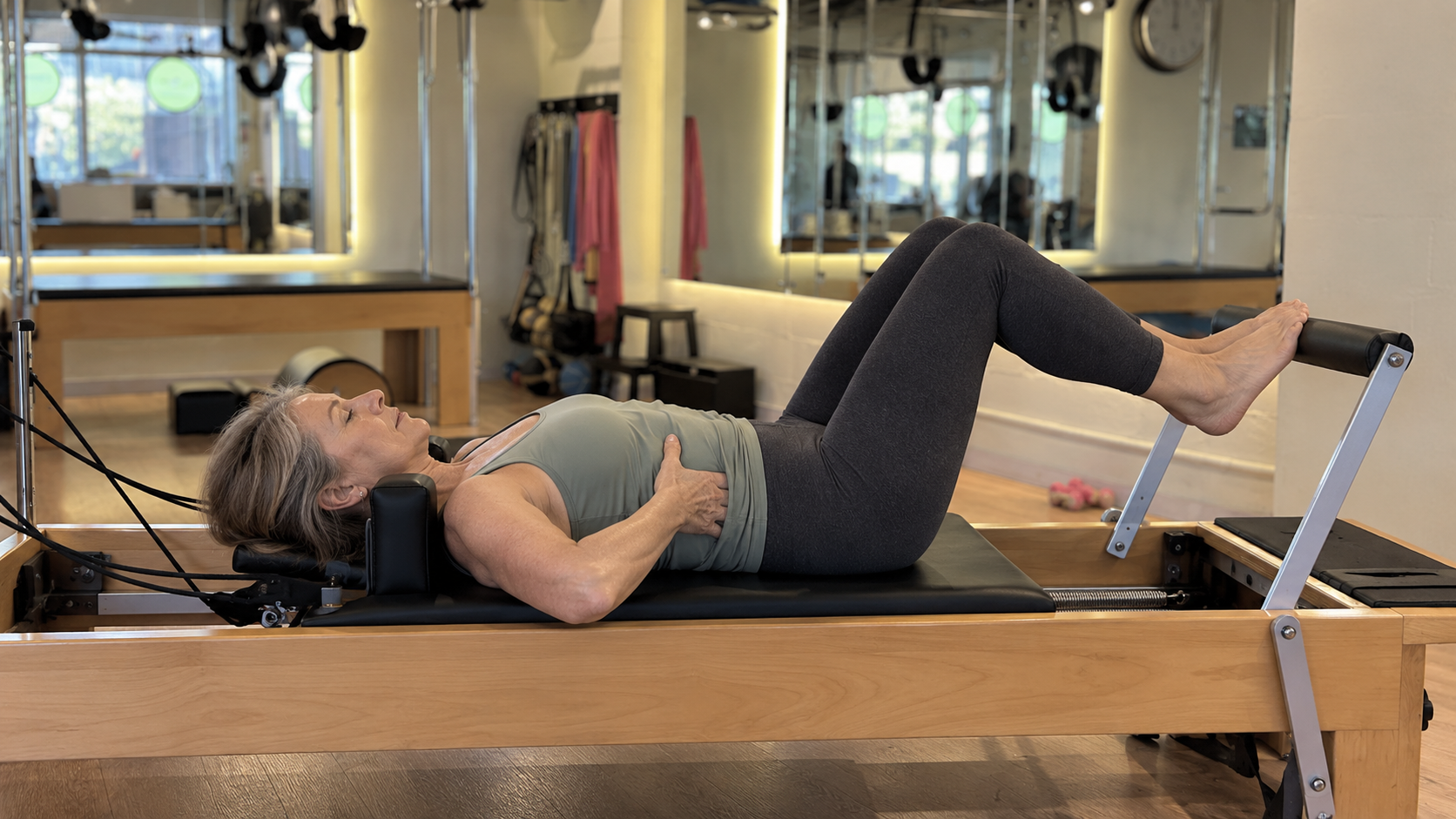
Your Ribcage Is Not a Rigid Box: How Breathing Mechanics Affect Your Shoulders, Spine and Pelvic Floor
Most of us think about the ribcage as protection for the heart and lungs. While that is one of its essential roles, the ribcage is not a rigid box. It is a flexible, moving structure that responds to every breath, reach, twist and change of position.
Healthy ribcage mobility and breathing mechanics can influence how comfortably you move through your upper back, lift your arms overhead and manage pressure through your abdomen and pelvic floor.
When movement becomes restricted or poorly coordinated, the body often finds another way. The shoulders may lift, the neck may tighten, the lower ribs may push forwards or breathing may become shallow and concentrated in the upper chest.
Understanding these relationships can help us look beyond the area where discomfort is felt and consider how the body is working as a whole.
What should happen to your ribs when you breathe?
During a comfortable inhalation, the diaphragm contracts and moves downwards. This creates more room within the chest as the lungs fill with air.
At the same time, the ribs move in several directions:
- The upper ribs and sternum move slightly upwards and forwards.
- The middle and lower ribs expand out towards the sides.
- The back of the ribcage also widens.
- The abdominal wall gently responds to the change in internal pressure.
As you exhale, the diaphragm relaxes and returns towards its domed position. The ribs move inwards and downwards as air leaves the lungs.
This movement is often described as three-dimensional or 360-degree breathing. It does not mean forcing the abdomen out or taking the largest breath possible. It means allowing the ribcage to adapt in the front, sides and back rather than directing every breath into one small area.
The amount and direction of movement will vary between individuals and change with posture, activity, effort and health. There is no single breathing pattern that needs to be maintained all day.
The anatomy of this movement is explained in more detail by the National Library of Medicine.
The ribcage and thoracic spine work together
Each rib connects to the thoracic spine through small joints at the back of the body. This means the ribs and the middle section of the spine cannot function completely independently.
When the thoracic spine bends, extends or rotates, the ribs need to accommodate that movement. Similarly, if parts of the ribcage are particularly stiff, the spine may have less freedom to move through that area.
Research has demonstrated that the ribcage contributes significantly to the mechanical behaviour and stability of the thoracic spine. It provides useful structure, but it must also allow enough movement for breathing and everyday tasks.
This relationship matters when you:
- Turn to reverse the car
- Reach into a high cupboard
- Swing a golf club or tennis racquet
- Roll over in bed
- Walk and allow the arms and trunk to rotate naturally
If the thoracic spine and ribs do not contribute comfortably, the body may borrow movement from the neck, lower back, shoulders or hips.
What does your ribcage have to do with your shoulders?
More than you might expect.
Your shoulder blades sit and move across the back of the ribcage. When you raise an arm overhead, the movement does not come from the shoulder joint alone. The shoulder blade needs to rotate and glide across the ribcage, while the thoracic spine and trunk provide an adaptable base.
If the upper back remains fixed or the ribcage cannot move comfortably, you may still get your arm overhead – but you might achieve it by:
- Shrugging the shoulder
- Arching excessively through the lower back
- Pushing the lower ribs forwards
- Tensing the neck
- Rotating or leaning the whole body
These compensations are not automatically harmful. The body is designed to adapt, and variation is a normal part of movement. However, if one strategy is used repeatedly or causes discomfort, it may be worth examining why other areas are not contributing.
A study published in the Archives of Physical Medicine and Rehabilitation found that thoracic position significantly affected shoulder range, strength and shoulder-blade movement during arm elevation. This supports the idea that shoulder movement should be considered in the context of the trunk rather than treated as an isolated joint. Read the study on PubMed.
Breathing is also a pressure-management system
The diaphragm does more than draw air into the lungs. It forms the upper part of a coordinated pressure system that also includes the abdominal wall, spinal muscles and pelvic floor.
You can think of this system as a flexible cylinder:
- The diaphragm forms the roof.
- The pelvic floor forms the base.
- The abdominal wall surrounds the front and sides.
- The spine and supporting muscles form the back.
As the diaphragm descends during inhalation, pressure within the abdomen changes. The abdominal wall and pelvic floor need to respond rather than remaining rigid.
During a relaxed breath, the pelvic floor will generally allow some lengthening or downward movement as you inhale, then recoil as you exhale. During lifting, coughing, running or other demanding tasks, the timing and level of muscular activity will change to suit the load.
Research from the University of Queensland has shown that the pelvic floor muscles contribute to both breathing and postural control. Their activity changes in response to respiration as well as movements that challenge the stability of the spine. Read the research on PubMed.
This is why breathing, abdominal control and pelvic floor function should not always be treated as separate issues.
Common signs that your body may be compensating
There is no universally perfect breathing pattern or posture. However, certain patterns may suggest that the body is relying heavily on one area.
Rib flare
Rib flare describes a position in which the lower front ribs remain lifted or pushed forwards. This can sometimes occur when someone tries to stand very tall, lift their arms or create stability by extending through the lower back.
The ribs naturally change position during movement, so rib flare is not inherently a problem. It becomes more relevant when someone cannot comfortably allow the lower ribs to soften or move in other directions.
Neck and shoulder tension
Some muscles around the neck and upper chest assist with breathing. They are particularly useful during exercise or when the body needs more air.
If they are doing most of the work during quiet breathing, however, you may notice the shoulders rising with each breath or persistent tension through the neck and jaw.
Shallow upper-chest breathing
Upper-chest breathing is normal during demanding exercise, stress or increased respiratory effort. Problems may arise when it becomes the only available strategy, even during rest or gentle movement.
Holding your breath
Breath-holding can be a useful strategy during short periods of high effort. Unintentional breath-holding during relatively simple movements may indicate that the body is creating more tension than the task requires.
Excessive bracing
Constantly pulling in the abdomen or trying to hold the ribs in a fixed position can limit natural movement. Stability does not require the body to remain rigid. Effective control involves being able to create tension when needed and release it when the task changes.
Why “stand up straight” is not always the answer
Posture is not one perfect position that everyone should hold.
Trying to force the shoulders back, flatten the ribs or continually pull in the abdomen may create more tension without addressing the reason a movement feels difficult.
A more useful question is:
Can your body move into and out of different positions with appropriate control?
Someone may look upright but still have limited rib movement. Another person may appear slightly rounded yet move comfortably and breathe efficiently. The goal is not to make every body look the same. It is to improve the movement options available to that individual.
How tailored Pilates can help
Pilates provides opportunities to explore breathing and ribcage movement in different positions and under varying levels of support and resistance.
An individually tailored program may examine:
- Where the ribcage expands during breathing
- How the thoracic spine moves during rotation and extension
- Whether the shoulder blades can glide comfortably over the ribs
- What happens through the trunk when the arms move overhead
- Whether the neck or lower back is taking over
- How breathing changes as exercises become more demanding
- How pressure is managed through the abdominal wall and pelvic floor
Equipment such as the Reformer, Cadillac, Wunda Chair and barrels can provide support, feedback or resistance according to the person’s needs. The aim is not to force a textbook posture. It is to help the body develop more adaptable and usable movement.
This may involve improving mobility in one area, building strength and control in another or simply helping someone recognise a habit they did not know they were using.
Your breath can reveal how your whole body is moving
Breathing is automatic, but it is also closely connected to posture, pressure and movement.
If your ribs are not moving well, the effects may be felt beyond your chest. Your shoulders, thoracic spine, neck, lower back or pelvic floor may all adapt to keep you moving.
By looking at ribcage mobility and breathing mechanics as part of the whole movement system, we can move beyond instructions such as “pull your shoulders back”, “hold your core” or “take a deep breath”.
At Pilates Connection, our experienced instructors tailor each program to the individual in front of them. We assess how your body currently moves, identify where additional support or mobility may be useful, and help you build strategies that transfer into everyday life.
Curious about your balance, posture or mobility? Let’s assess it together.
This article provides general information and is not a substitute for individual medical advice. Seek advice from an appropriate healthcare professional if you experience unexplained breathing difficulties, persistent pain, incontinence or pelvic pressure.
Sorry, the comment form is closed at this time.